
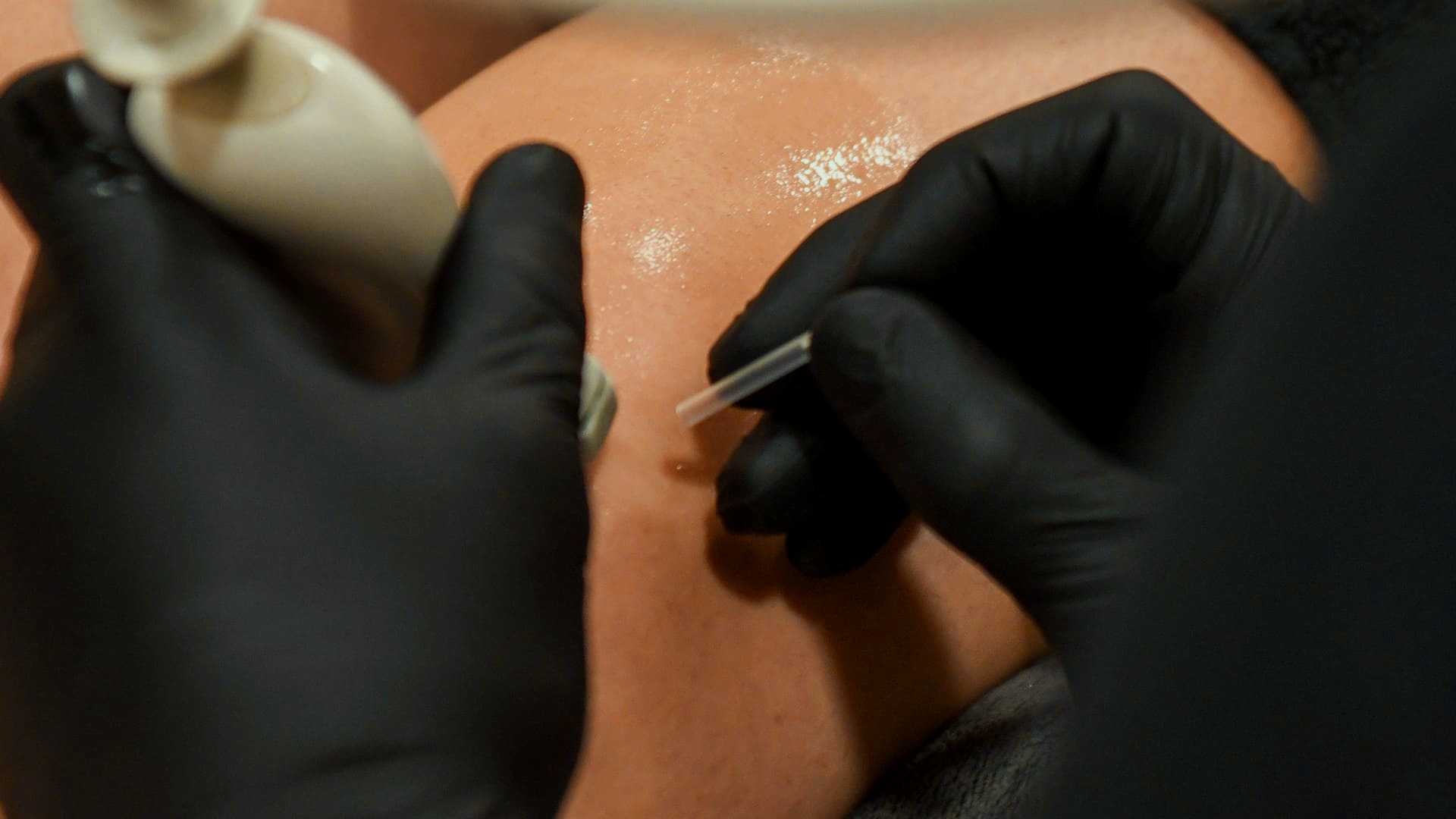
Dry needling
Needle technique to deactivate trigger points and tight muscles that do not respond to manual therapy.
Dry needling treats myofascial trigger points with a fine needle, without injecting any substance: hence the name. It is the option when tight muscle will not release with hands alone.
What a trigger point is
It is an area of maximum shortening within a taut band of muscle. It hurts under pressure, but it also refers pain to other areas and causes weakness and loss of mobility. It explains many cervical headaches, shoulder pain and low back discomfort that never show up on imaging.
How the treatment works
We locate the point responsible and apply a sterile single-use needle. The muscle responds with a brief involuntary twitch that releases the accumulated tension; after that response, elasticity improves and referred pain drops immediately in most cases.
What you will feel
During the technique there is an intense but very brief discomfort, a matter of seconds. Afterwards a feeling similar to muscle soreness for 24 to 48 hours is normal, eased by heat and gentle movement. As nothing is injected, there are no systemic side effects.
Never as the only treatment
Needling opens a window: pain drops and mobility returns. If that window is not used to correct what caused the overload (posture, repeated movement, lack of strength), the trigger point comes back. That is why we always integrate it into a plan with exercise.
Frequently asked questions
Does dry needling hurt a lot?
Is it the same as acupuncture?
Can I train after a session?
Other services
You may also need
 Physiotherapy and rehabilitationPain treatment, recovery of movement and functional rehabilitation after surgery or injury.
 OsteopathyManual therapy that looks for the origin of the symptom and restores mobility to the whole body.
 Sports injuriesTreatment and rehabilitation for athletes, from the injury to the return to competition.
Your recovery
starts here.
We are here to support you at every step of your wellbeing.